What is a throughline?
Stanislavski came up with it for his actors.
The short answer
A throughline (also written through line or through-line) is the thread that runs through a story from the first scene to the last and ties everything along the way together.
In most stories that thread is a character wanting something, the things that get in the way, and what the chase does to them. You’ve found it when you can say it in one sentence and every scene either pushes along that line or pulls against it.
Outside of writing the word works the same way at a larger scale. Merriam-Webster defines it as the element or theme that recurs across the items in a series or the parts of a whole, which is why critics talk about the throughline of a director’s films or a band’s records.
Throughline, through-line or through line?
All three are correct. Merriam-Webster files it under “through line” and lists “throughline” and “through-line” as variants, and you’ll find all of them in screenwriting books. “Thruline” is the informal spelling, and the plural is throughlines. (Our app, the Throughline App, went with one word, obviously.)
Where the word comes from
The idea started in the rehearsal room. Konstantin Stanislavski had his actors break a role into units, each with its own objective: what the character wants in this stretch of the play. Lined up, those objectives form what English translations call the through-line of action, the line that carries a character from their first entrance to their last exit, toward their super-objective, the one thing they want across the whole play.
Writers borrowed it because the page has the same problem the stage does. A scene can be beautifully written and still feel like it wandered in from another movie, and the throughline is how you notice.
Narrative, emotional and thematic throughlines
Most stories run several throughlines at once, and three kinds come up again and again. Finding Nemo has a clean example of each.
The narrative throughline is what happens: the goal, the obstacles, the plot that gets the character from the start to the end. Marlin crosses the ocean to get his son back from a dentist’s fish tank in Sydney.
The emotional throughline is what the plot does to the character underneath. Marlin starts as a father who can’t let Nemo out of his sight, and ends up letting him swim into a fishing net to save a school of fish.
The thematic throughline is the question the whole story keeps turning over: how far can you protect someone you love before the protecting starts holding them back? Marlin argues it from one side. Nemo, stuck in the tank and learning what he can do with his small fin, argues it from the other.
The best scenes carry more than one line at once. That fishing net scene is where Marlin’s narrative and emotional throughlines meet: to finish the plot, he has to do the one thing he couldn’t do for the entire film.
A related word you’ll hear is plotline. A plotline is one strand of events, like the A-story or a romance, and each plotline can have its own throughline. The thematic one is usually what makes several plotlines feel like the same story.
The four throughlines
If you’ve searched for “throughlines” in the plural, you’ve probably run into Dramatica, a story theory that says a complete story argues its central problem from four perspectives at once:
- the Overall Story, the “they” view of the conflict everyone is caught up in,
- the Main Character, the “I” view of living through it,
- the Influence Character, the “you” who challenges the main character’s way of seeing things,
- and the Relationship Story between those two, the “we”.
Dramatica goes a lot deeper than this, and the core idea travels well even if you never touch the rest of it: the same story looks very different depending on whose line you’re following.
How to find the throughline in your own story
- Write it in one sentence. Who wants what, and what stands in the way? If it takes three sentences, you might have two stories, or one story and a B-plot that thinks it’s the A-plot.
- Check every beat against that sentence. Each one should push the line forward or push back against it. Beats that just sit next to it are usually where the middle sags.
- Give each plotline its own line. The A-story, the B-story and the romance each need their own throughline, and the thematic one is what ties them together.
- Track the emotional line separately. The plot is easy to see on a page. How your character feels at each beat is very easy to lose, especially in the second act.
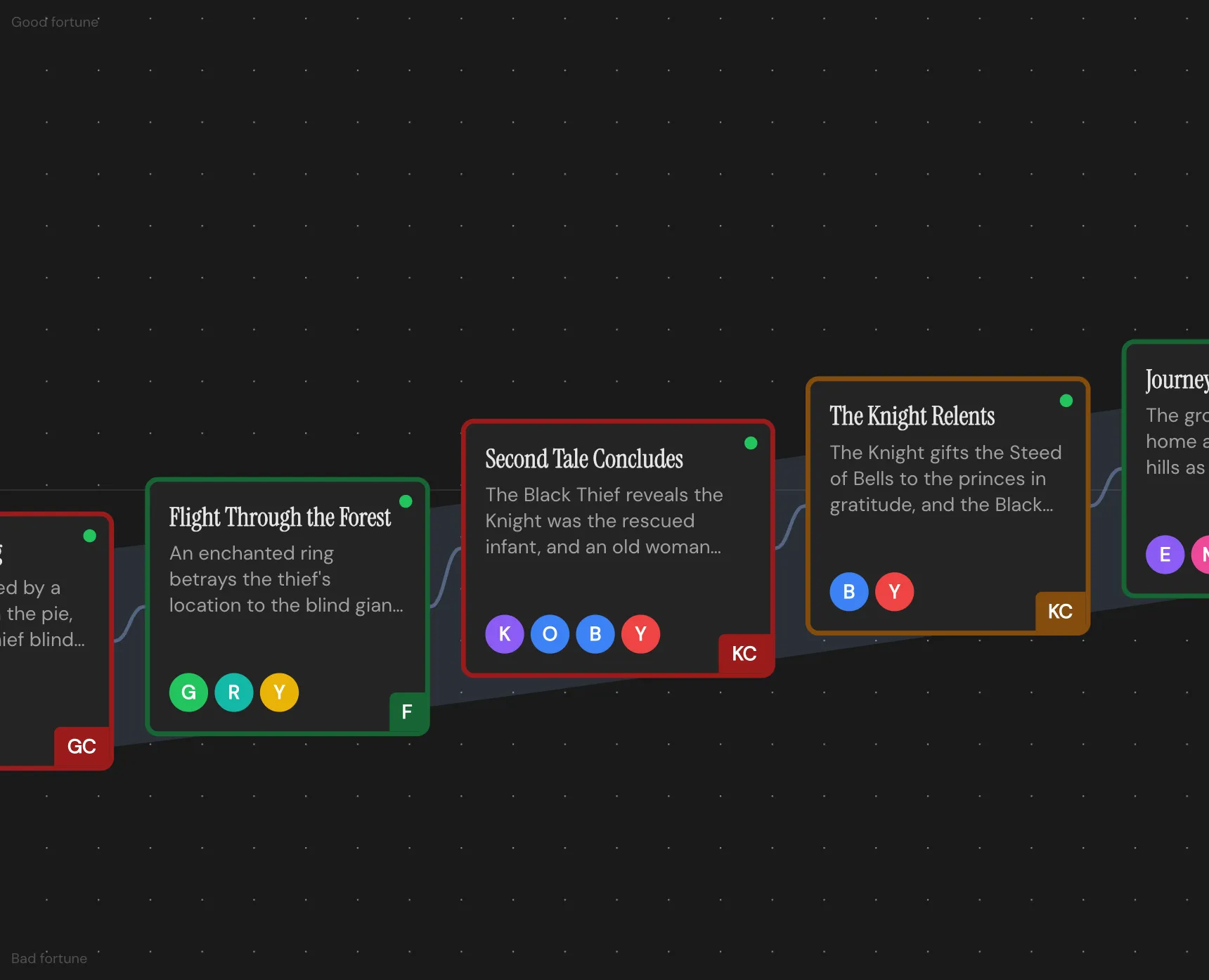
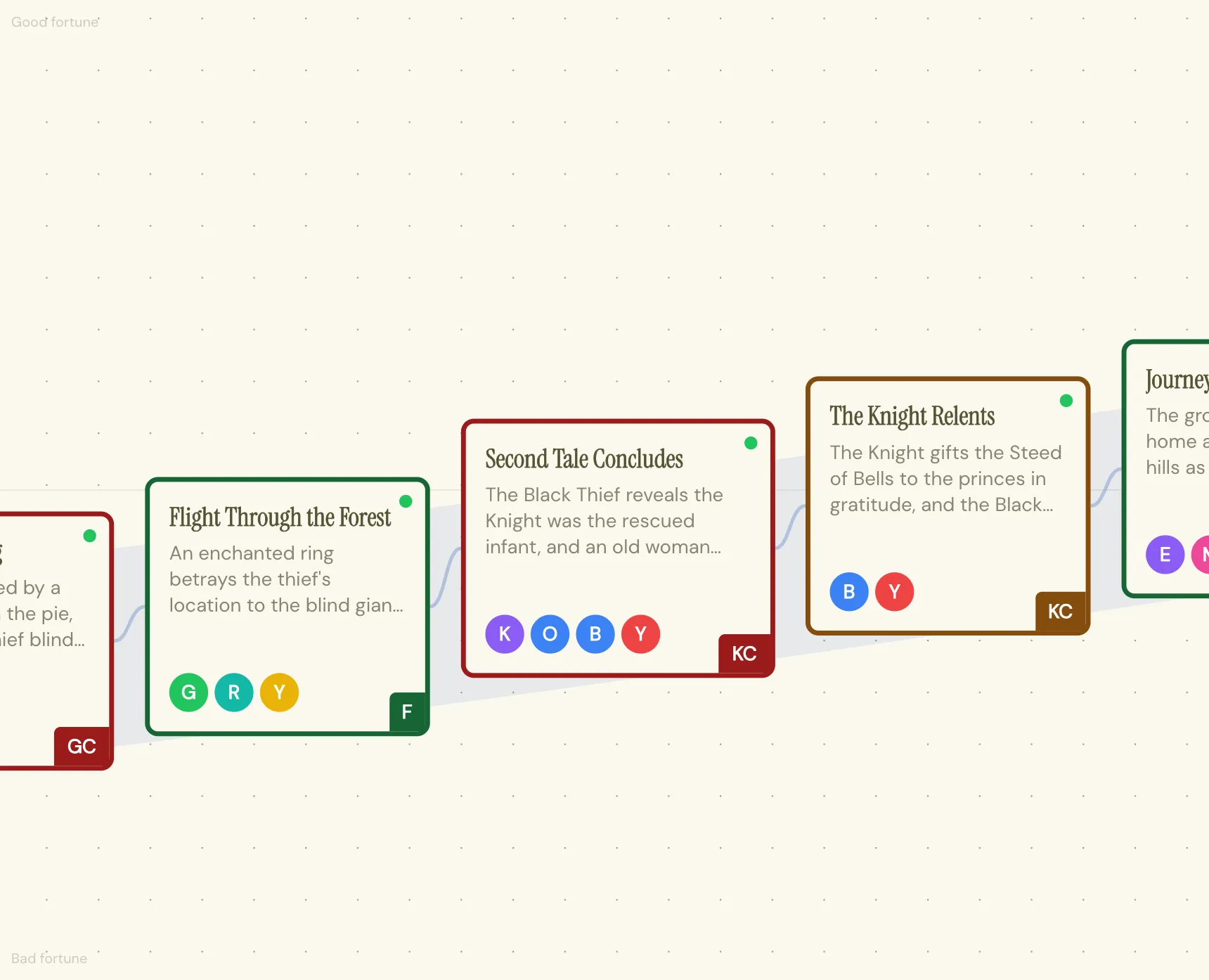
Tracking the emotional line on its own: each scene sits higher or lower depending on how things stand for the heroes, so a flat stretch or a missing low point shows at a glance. Here a fairy tale climbs back toward good fortune, charted in the Shape Workspace of the Throughline App.
Where the Throughline App comes in
Keeping track of every throughline in a story, along with its plotlines, Characters, Settings and Beats, is the job the Throughline App was built around. In the Draft Workspace the Throughline row is your story’s spine as cards you can drag, stack and reorder, with Characters and Settings cast onto each Beat. Shape gives every plotline its own Arc between two poles you name yourself (hope and despair, trusted and exposed, whatever fits), so the emotional throughline turns into a curve you can actually look at and lay a classic Story Shape over. When the line holds, Write turns it into a properly formatted screenplay.
So here’s the pitch. Beyond the board and the Arcs, the Throughline App maps your cast’s relationships as a Constellation you can scrub through Beat by Beat, comes with the classic story structures built in as decks you deal straight onto your story, and hands you an industry-standard screenplay PDF when you’re done. You buy it once, it runs offline on your own machine, it can import any script you may already have and pull out its Characters and Settings for you. The easiest test is the story you’re stuck on right now: bring it in and see what the cards show you!
Whatever app you use, put the sentence on paper before you start a draft and check the finished draft against it. If the two don’t match anymore, one of them needs rewriting, and sometimes it’s the sentence: the draft found a better story than the one you planned.